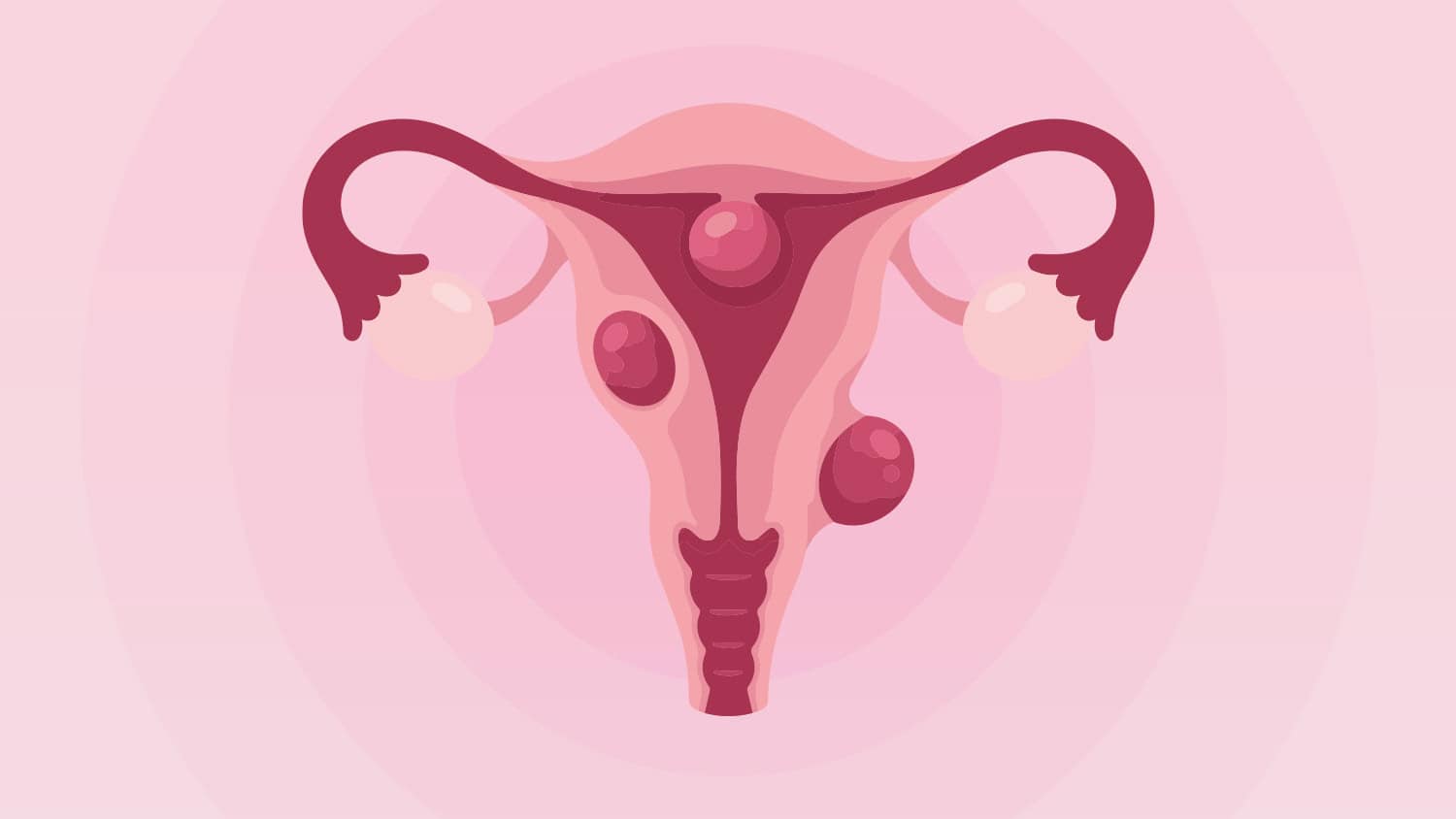
Your scan shows a 4 cm fibroid. Does that mean cancer, surgery, or trouble getting pregnant? A number on a report can feel scary, but a measurement is not a verdict. Most fibroids are benign (not cancer). Size does not predict symptoms: A small fibroid can cause heavy bleeding, while a large one may cause none.12 Between 20% and 80% of women develop fibroids by age 50.2
Fibroids (leiomyomas) are growths of muscle and connective tissue in the uterus. Experts do not know exactly why they form, but genes and hormones (estrogen and progesterone) play a role. You can have one or several.2 Fibroids are more common in Black women, who often develop them earlier, and in women with a family history.12
On this page
- Is there a size at which a fibroid becomes dangerous?
- Fibroid sizes in mm and cm: What the numbers mean
- Why does location matter more than size?
- Large fibroids: When size does cause problems
- Does a growing fibroid mean something is wrong?
- How is fibroid size measured?
- Does size decide treatment?
- Can a 3 cm or 4 cm fibroid affect fertility?
- Can teenagers develop fibroids?
- Common myths about fibroids
- What should you track or ask your doctor?
- When to see a doctor?
Key takeaways
- There is no set size at which a fibroid becomes “dangerous” or automatically needs surgery.
- A small fibroid just under the uterine lining can cause heavier bleeding than a large one on the outside of the uterus.
- Size in millimeters (mm) or centimeters (cm) tells you how big a fibroid is, not whether it is cancer.
- Larger fibroids may lead to pressure on the bladder, bowel, or sometimes the kidneys.
- Fibroids are typically benign, but fibroids that grow after menopause require assessment.
- The treatment varies according to symptoms, location, age, and plans for pregnancy.
Is there a size at which a fibroid becomes dangerous?
No fibroid size is automatically dangerous. A 10 cm fibroid may need no treatment, while a 2 cm fibroid just under the uterine lining can cause heavy bleeding. Doctors, following guidance from the American College of Obstetricians and Gynecologists (ACOG), look at symptoms, location, growth over time, and your goals, such as future pregnancy.1
Fibroid sizes in mm and cm: What the numbers mean
1 cm equals 10 mm. The terms “small,” “medium,” and “large” are not standardized danger terms. These comparisons are illustrative.
| Illustrative label | Example measurement | Rough comparison |
| Small | 10–20 mm (1–2 cm) | Pea to grape |
| Small–medium | 20–30 mm (2–3 cm) | Cherry tomato |
| Medium | 30–40 mm (3–4 cm) | Walnut |
| Medium–large | 40–50 mm (4–5 cm) | Lime |
| Large | 50–100 mm (5–10 cm) | Lemon to grapefruit |
A 3 cm fibroid measures 30 mm; a 4 cm fibroid, 40 mm. Neither size automatically needs treatment.
Why does location matter more than size?
A 2 cm submucosal fibroid (beneath the uterine lining) may bleed more than a 10 cm subserosal fibroid (outside the uterus).34
| Type | Where | Common symptoms |
| Submucosal | Under the uterine lining | Heavy or prolonged menstrual bleeding |
| Intramural | In the uterine muscle wall | Heavy bleeding, pelvic pain or pressure |
| Subserosal | On the outside of the uterus | Pressure, fullness, bladder or bowel symptoms |
| Pedunculated | Attached to the uterus by a stalk | Symptoms vary by location; sudden pain if twisted |
Fibroids that grow toward the lining are more often linked with heavy bleeding, whereas those that grow outward can lead to pressure or fullness.4
Fibroids that distort the uterine cavity (inside space) can affect implantation (pregnancy attaching) or increase miscarriage risk. Many women with fibroids still get pregnant.5
Large fibroids: When size does cause problems
Large fibroids can compress the bladder, bowel, or ureters (urine-carrying tubes), leading to frequent urination, constipation, fullness, or back pain. Very large fibroids can press on the ureters and block urine from draining from the kidneys. This is uncommon but needs prompt care. Rarely, a fibroid degenerates (loses blood supply) or twists on its stalk, causing severe pain.4
Heavy bleeding may cause iron-deficiency anemia (low healthy red blood cells), fatigue, and breathlessness. Heavy bleeding that soaks through pads or tampons hour after hour needs urgent care.67
Does a growing fibroid mean something is wrong?
Not necessarily. Fibroids can grow, remain unchanged, or shrink. They tend to shrink as the hormone levels drop after menopause (12 months without a period). Growth alone is rarely a sign of cancer. Bleeding after menopause, or any new growth after menopause, should be checked. A rare cancer called leiomyosarcoma (uterine muscle cancer) is generally thought to develop separately, rather than from a preexisting fibroid.28
The U.S. Food and Drug Administration (FDA) estimates that about 1 in 495 to 1 in 1,100 women having surgery for presumed fibroids have a hidden leiomyosarcoma. Other reviews estimate a lower risk.12 This is a surgical-population estimate, not the risk for everyone with fibroids.9 Fast growth together with new bleeding or pain warrants further testing.1
How is fibroid size measured?
Fibroids can be measured using ultrasound (sound-wave imaging), and an MRI (magnetic resonance imaging, a detailed scan that uses magnets) can help map complex cases. Reports may list three dimensions: “40 × 30 × 25 mm” means 4 × 3 × 2.5 cm, not a danger score. The report may include multiple fibroids with various sizes and their locations. Your OB-GYN can compare scans over time to see whether a fibroid has changed.104
A saline sonogram (ultrasound with fluid) shows cavity distortion; hysteroscopy (camera inside the uterus) can inspect it.11
Does size decide treatment?
No. An OB-GYN considers the symptoms, location, number, age, and fertility goals.1213 Treatment choices include:
- Watching and waiting (observation)
- NSAID (nonsteroidal anti-inflammatory drug) pain relievers, such as ibuprofen (Advil, Motrin)
- Tranexamic acid (Lysteda) for heavy bleeding
- Birth control pills or a hormonal IUD (intrauterine device)
- GnRH (gonadotropin-releasing hormone) medicines, which block hormones to shrink fibroids
- Iron for anemia14
Medicines may control symptoms without removing fibroids. These GnRH medicines can shrink fibroids and ease bleeding. They can also cause hot flashes and bone thinning, so doctors usually prescribe them for a limited time. Fibroids often regrow after you stop.141
The FDA has approved two hormone-blocking combination pills for heavy bleeding from fibroids in adults who have not gone through menopause: Myfembree (relugolix) and Oriahnn (elagolix). Both carry blood-clot warnings, can cause bone loss, and are limited to 24 months of use. Safety in teens has not been established.1516
- Myomectomy removes fibroids but keeps the uterus; new ones can form later.14
- Uterine artery embolization (UAE) blocks blood flow to the fibroids so they shrink. Ask how it may affect future pregnancy.17
- A hysterectomy involves the surgical removal of the uterus. This means that no uterine fibroids or pregnancy can occur after the procedure.18
- Radiofrequency ablation uses heat to shrink fibroids.1
- Endometrial ablation destroys the lining of the uterus but does not destroy bulky fibroids. It is not an option if you want to get pregnant.19
Ask if your surgeon uses a power morcellator (a tool that cuts tissue into small pieces). The FDA warns it can spread an unexpected cancer, so ask about safety steps such as a containment bag.9
Can a 3 cm or 4 cm fibroid affect fertility?
Sometimes, especially if a fibroid distorts the uterine cavity or blocks a fallopian tube (egg pathway). Pregnancy loss, fetal position, or delivery may also be affected.5
Can teenagers develop fibroids?
Yes, but rarely before age 20. Heavy periods or cramps usually have other explanations.20 Teen cycles often range from 21 to 45 days.21 Bleeding disorders (clotting problems) are another possibility. If the bleeding is heavy, a blood count, ferritin (stored-iron test), and tests for clotting conditions may be done before considering fibroids as the cause.23
Common myths about fibroids
- “Large means cancer.” False. Most fibroids are benign.2
- “Over 5 cm always needs removal.” False. Symptoms and circumstances guide care.14
- “Herbs dissolve fibroids.” There are no herbal treatments proven to be effective for the management of fibroid symptoms.14
- “Birth control causes fibroids.” There is no clear evidence that it causes fibroids to develop. Hormonal birth control can ease heavy bleeding, although some methods may make existing fibroids grow a little.1
- “Fibroids always become cancer.” False. Fibroids are usually benign; leiomyosarcoma is a different, rare uterine cancer.29
- “A hysterectomy is the only fix.” False. Medicines, procedures that shrink fibroids, and myomectomy can also help. Hysterectomy is the only way to ensure uterine fibroids cannot return.1214
What should you track or ask your doctor?
- Keep track of pad changes, clots, pain, bathroom symptoms, and days missed from school.724 The Heavy Period Quiz can help you judge whether your bleeding counts as heavy.
- Bring previous scans. Ask: “Where is the fibroid? Does it change the shape of the uterine cavity? Has it grown?”
- Ask: “Do I need an anemia blood test or another scan? What changes should I watch for?”
- Ask whether your insurance covers imaging and follow-up visits, and what your copay will be.
When to see a doctor?
- Your periods last longer than 8 days, you soak through one or more pads or tampons every hour for more than two hours in a row, or you bleed between periods. The International Federation of Gynecology and Obstetrics (FIGO) describes normal adult cycles as 24 to 38 days, with bleeding lasting up to 8 days.722
- For teens: periods last longer than 7 days, or you need a new pad or tampon every 1 to 2 hours.21
- Bleeding makes you miss school, work, or activities.
- Pressure on the bladder or bowel, difficulty passing urine, or persistent pain in the pelvis.1
- You have bleeding after menopause.8
- You are pregnant, trying to get pregnant, or have had miscarriages.5
Seek emergency care if:
Frequently asked questions
Not by size alone. Heavy bleeding can be caused by a fibroid that is only 2 cm below the uterine lining. It’s the symptoms, not the numbers, that are the issue.
Some doctors consider 5 cm large, but there is no universal cutoff. Size alone does not tell you whether you need treatment or whether complications will develop.
Yes, sometimes. A 7 cm fibroid that is not associated with any troublesome symptoms may be just monitored.
No, even a 10 cm fibroid isn’t necessarily a surgery case. An OB-GYN takes into consideration symptoms, location, pressure on neighboring organs, and plans for pregnancy.
Removed fibroids do not regrow, but new ones can form after myomectomy (fibroid-removal surgery). After hysterectomy (uterus removal), uterine fibroids cannot return.
Sometimes. Fibroids often shrink on their own after menopause, when estrogen and progesterone levels fall. Before menopause, they may grow, stay the same, or shrink. No herbal remedy has been proven to reliably dissolve them, so if there is unexplained pain or bleeding, it should not be overlooked.
Possibly, if it changes the shape of the uterine cavity (inside space). Fibroids in other locations may have little effect, and many women who have fibroids can conceive.
Usually not. Growth of fibroids alone does not indicate cancer. Any new or growing mass following menopause, however, should be evaluated, particularly if there is also bleeding.
Yes. If the fibroid is large, it may cause a bulging appearance or fullness in the lower part of the belly. But bloating alone cannot confirm a fibroid; ultrasound can help.
Last medically reviewed on
References
Our commitment to accuracy is paramount; we use high-quality sources, including peer-reviewed studies, to support the facts in our articles. Learn more about our Editorial Process.
- American College of Obstetricians and Gynecologists (ACOG). Uterine fibroids. (Last reviewed: December 2025). acog.org
- Office on Women’s Health (OASH). Uterine fibroids. (Last updated: February 28, 2025). womenshealth.gov
- Cleveland Clinic. Uterine fibroids. (Last updated: August 6, 2026). my.clevelandclinic.org
- American Society for Reproductive Medicine (ASRM). What are fibroids? (Revised: 2023). reproductivefacts.org
- American Society for Reproductive Medicine (ASRM). Fibroids and fertility. (Revised: 2023). reproductivefacts.org
- Office on Women’s Health (OASH). Iron-deficiency anemia. (Last updated: October 24, 2025). womenshealth.gov
- American College of Obstetricians and Gynecologists (ACOG). Heavy menstrual bleeding. (Last reviewed: May 2026). acog.org
- American College of Obstetricians and Gynecologists (ACOG). Perimenopausal bleeding and bleeding after menopause. (Last reviewed: February 2024). acog.org
- U.S. Food and Drug Administration (FDA). Power morcellation during gynecologic laparoscopic surgeries. (Content current as of: August 20, 2026). fda.gov
- American College of Obstetricians and Gynecologists (ACOG). Ultrasound exams. (Last reviewed: October 2025). acog.org
- American Society for Reproductive Medicine (ASRM). Saline infusion sonohysterogram (SHG). (Revised: 2021). reproductivefacts.org
- American College of Obstetricians and Gynecologists (ACOG). Management of symptomatic uterine leiomyomas. Practice Bulletin No. 228. Obstet Gynecol. 2021;137(6):e100–e115. acog.org
- Eunice Kennedy Shriver National Institute of Child Health and Human Development (NICHD). What are the treatments for uterine fibroids? (Last reviewed: November 2, 2018). nichd.nih.gov
- American Society for Reproductive Medicine (ASRM). Treatment of uterine fibroids. (Revised: 2023). reproductivefacts.org
- U.S. Food and Drug Administration (FDA). Myfembree (relugolix, estradiol, and norethindrone acetate) prescribing information. (Revised: August 2025). accessdata.fda.gov
- U.S. Food and Drug Administration (FDA). Oriahnn (elagolix, estradiol, and norethindrone acetate) prescribing information. (Revised: December 2025). accessdata.fda.gov
- American College of Obstetricians and Gynecologists (ACOG). Uterine artery embolization. (Last reviewed: May 2026). acog.org
- American College of Obstetricians and Gynecologists (ACOG). Hysterectomy. (Last reviewed: May 2025). acog.org
- U.S. Food and Drug Administration (FDA). Endometrial ablation for heavy menstrual bleeding. (Content current as of: October 25, 2021). fda.gov
- MedlinePlus Medical Encyclopedia. Uterine fibroids. (Reviewed: March 17, 2026). medlineplus.gov
- American College of Obstetricians and Gynecologists (ACOG). Menstruation in girls and adolescents: using the menstrual cycle as a vital sign. Committee Opinion No. 651. December 2015. acog.org
- Munro MG, Critchley HOD, Fraser IS; FIGO Menstrual Disorders Committee. The two FIGO systems for normal and abnormal uterine bleeding symptoms and classification of causes of abnormal uterine bleeding in the reproductive years: 2018 revisions. Int J Gynaecol Obstet. 2018;143(3):393–408. doi.org
- American College of Obstetricians and Gynecologists (ACOG). Screening and management of bleeding disorders in adolescents with heavy menstrual bleeding. Committee Opinion No. 785. September 2019. acog.org
- American College of Obstetricians and Gynecologists (ACOG). Abnormal uterine bleeding. (Last reviewed: August 2025). acog.org
Update history
Our team monitors the health and wellness space to keep articles current.
Current version (November 4, 2026) — Medically reviewed by Dr. Sadaf Iftikhar, MBBS, FCPS. Written by Dr. Maham Shahid, MBBS.