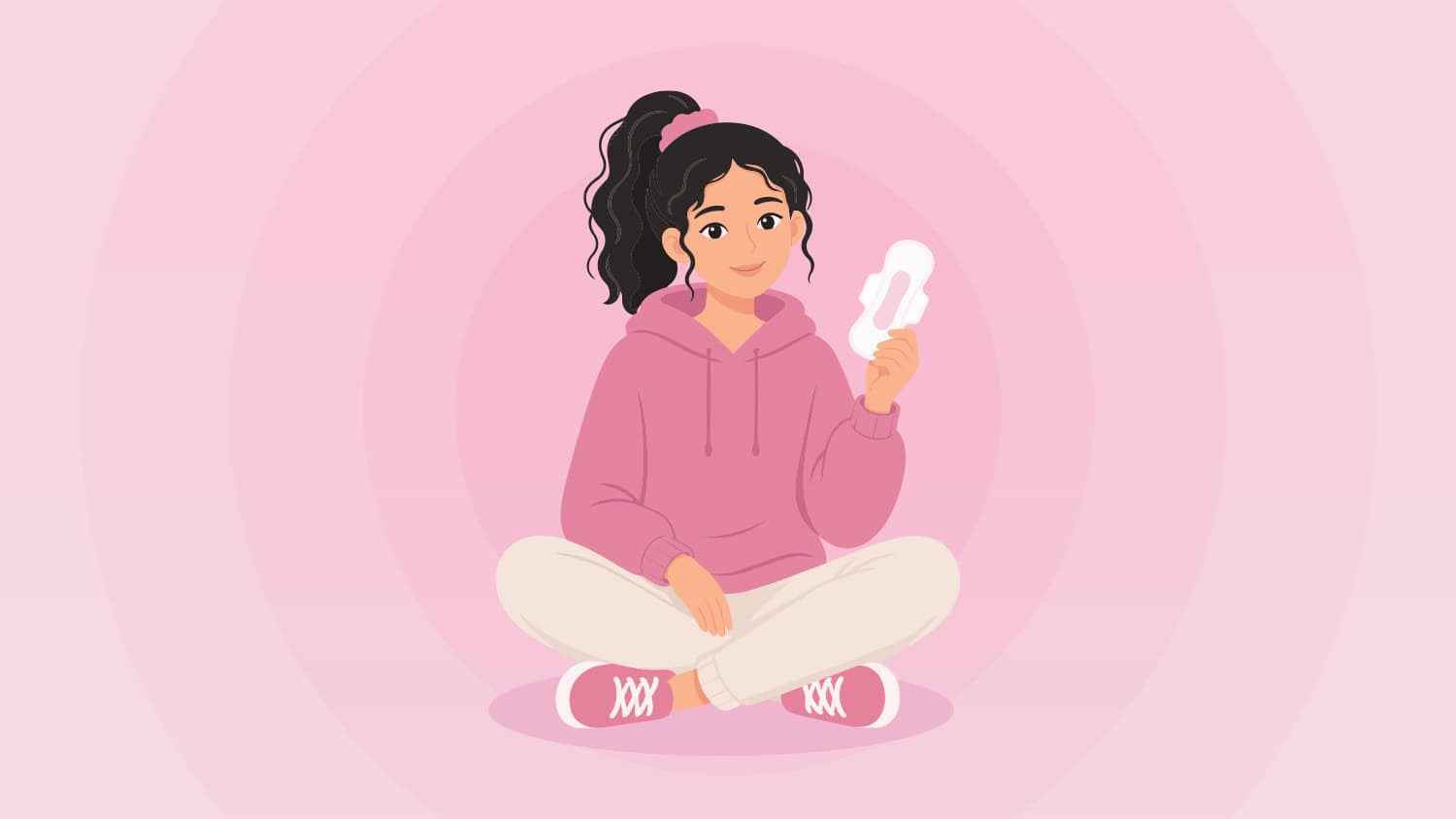
What if your daughter was at school and found blood in her underwear? What would you want her to know at that moment? Most girls in the U.S. get their first period at around 12 and a half.1 A short, calm talk before it arrives makes that day easier. Talking to your daughter about periods is not about having all the perfect answers. You need to explain what a period is, show her what to do, and let her know she can always come to you.
Key takeaways
- Start talking about periods before her first one, in words that fit her age.
- Explain where period blood comes from and what changes to expect, without making it frightening or shameful.
- Show her how to use period products, and pack a small kit for school and outings.
- Leave room for awkward questions and mixed feelings; it is a conversation, not a speech.
- Teach her which symptoms need a doctor, and that serious pain or heavy bleeding should never be ignored.
When should you talk to your daughter about periods?
Start talking about periods when body changes begin, which can be as early as age 8.2 Begin with a simple explanation so your daughter has time to understand what to expect before her first period. As she grows, you can introduce practical details about bleeding, cramps, and menstrual products.
In the United States, the average age at the first period (menarche) is around 12 and a half, usually two to three years after breast development begins.12 Puberty can start earlier, so if you wait until your daughter “looks” like a teenager, you may leave her unprepared.
A good cue is when she notices pads, asks about body changes, or hears classmates discussing puberty. If her period has already started, you can begin with her immediate questions.
Here is what to cover at each age. The ages are a guide; follow her development and her questions rather than the calendar.
Ages 8 to 10
Puberty can begin as early as 8, so this is the time for the basics.2 Explain that her body will change over the next few years, that breasts and body hair usually come first, and that periods come later. Use the real names for body parts, including vulva, vagina, and uterus, so she has the words when she needs them. Keep it short, and let her know she can ask anything.
Ages 11 to 12
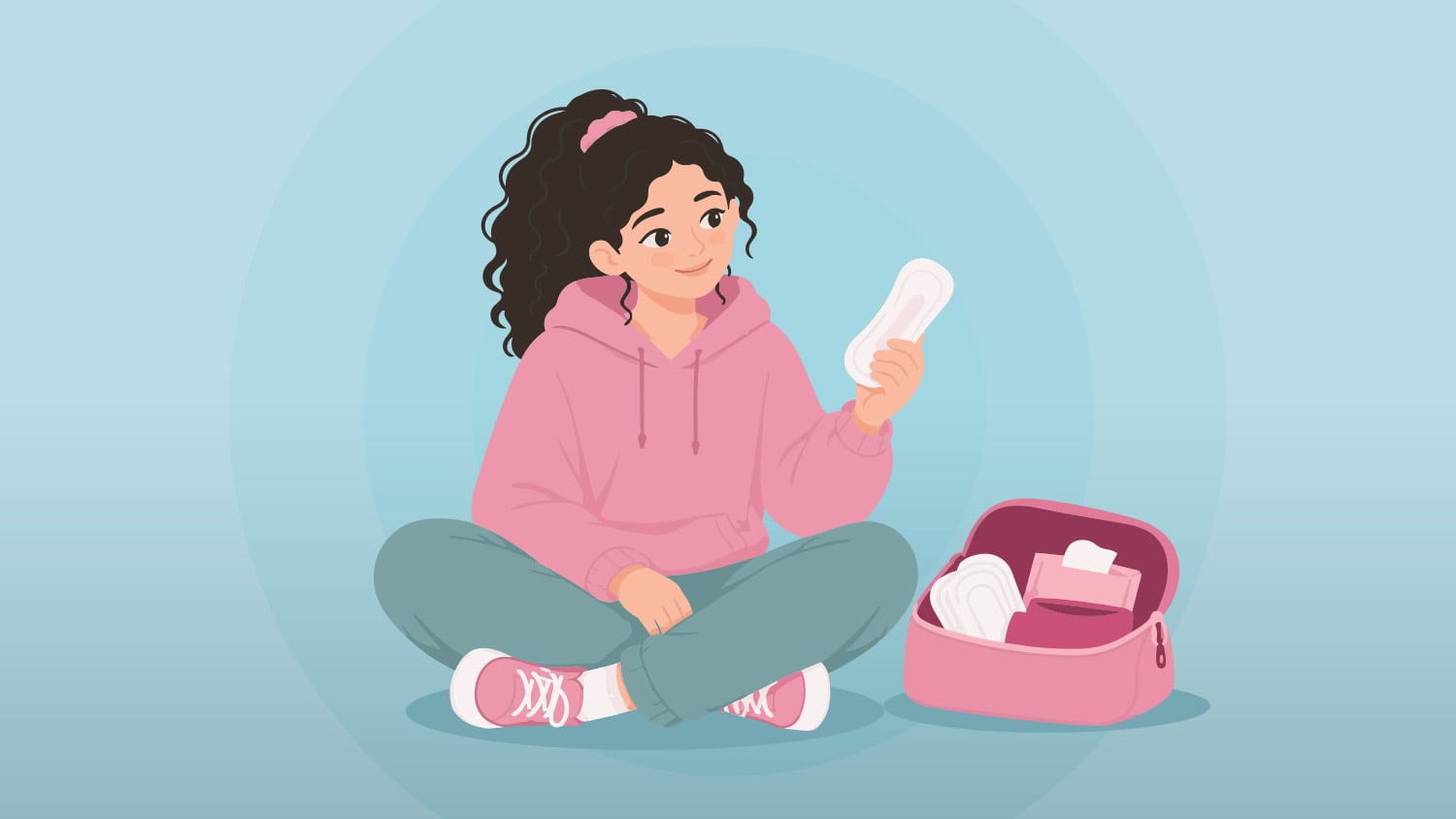
Most girls get their first period at around 12 and a half, so by now she should know exactly what one is and what to do.1 Show her a pad, let her practice attaching one to underwear, and pack a small kit for her school bag. Walk through what she would do if her period started in class. The sections on what to expect and on products below cover this in detail.
Age 13 and up
Once her periods have started, the conversation shifts to managing them and to her body as her own. Talk about cramps and what helps, about cycles that are still settling, and about when a period needs a doctor. This is also the age to talk about pregnancy and consent, her right to say yes or no, in plain terms. The cramps section and the when-to-see-a-doctor list below give you the details.
How do you explain what a period actually is?
A period is when blood and tissue from the lining of the uterus leave the body through the vagina. The uterus, or womb, is a pear-shaped organ in the lower belly where a baby can grow. Hormones, the body’s chemical messengers, prepare the lining of the uterus for a possible pregnancy each month. If no pregnancy develops, the lining comes out of the body in the form of a period.3
If you’re explaining this to a younger daughter, you may want to say: “In your body there is a part called the uterus. As you grow, your uterus changes, and sometimes there is a little blood coming out of your vagina. This is a period. It isn’t a wound, and it isn’t because you’re sick.”
Period blood comes from the vagina, not from the opening where urine comes out (the urethra). Girls have separate openings for each. Using the real names helps clear up common mix-ups.
How can you make the conversation less awkward?
Pick a relaxed moment, like a car ride or while folding laundry. To begin with, ask her, “What do you know about periods?” Her answer tells you whether you need to correct a misconception or fill in missing information.
If she seems uncomfortable, give her space. She can ask questions out loud, write them down, or talk to another trusted adult. All that really matters is her comfort, and you don’t need to explain everything just now.
Avoid describing periods as dirty, a punishment, or proof that she is now an adult. She may feel curious, worried, proud, indifferent, or upset. None of those feelings needs correcting. Respect her privacy, too. Don’t announce her first period to relatives or friends without her permission.
What should she know before her first period?
Before her first period, your daughter should know how to:
- Recognize period bleeding
- Manage it with a tampon, a pad, or other product
- Know what to expect in the months after
What might her first period look like?
Her first period blood may be pink, red, or even reddish-brown spots rather than a flow of blood. Her first period may be light.
A period usually lasts 2 to 7 days.3 Needing a new pad or tampon every 1 to 2 hours is a reason to call the doctor.3
The first few periods may be irregular. Cycle lengths of 21 to 45 days are common in teenagers, counting from the first day of one period to the first day of the next. It may take time before a regular pattern develops.3
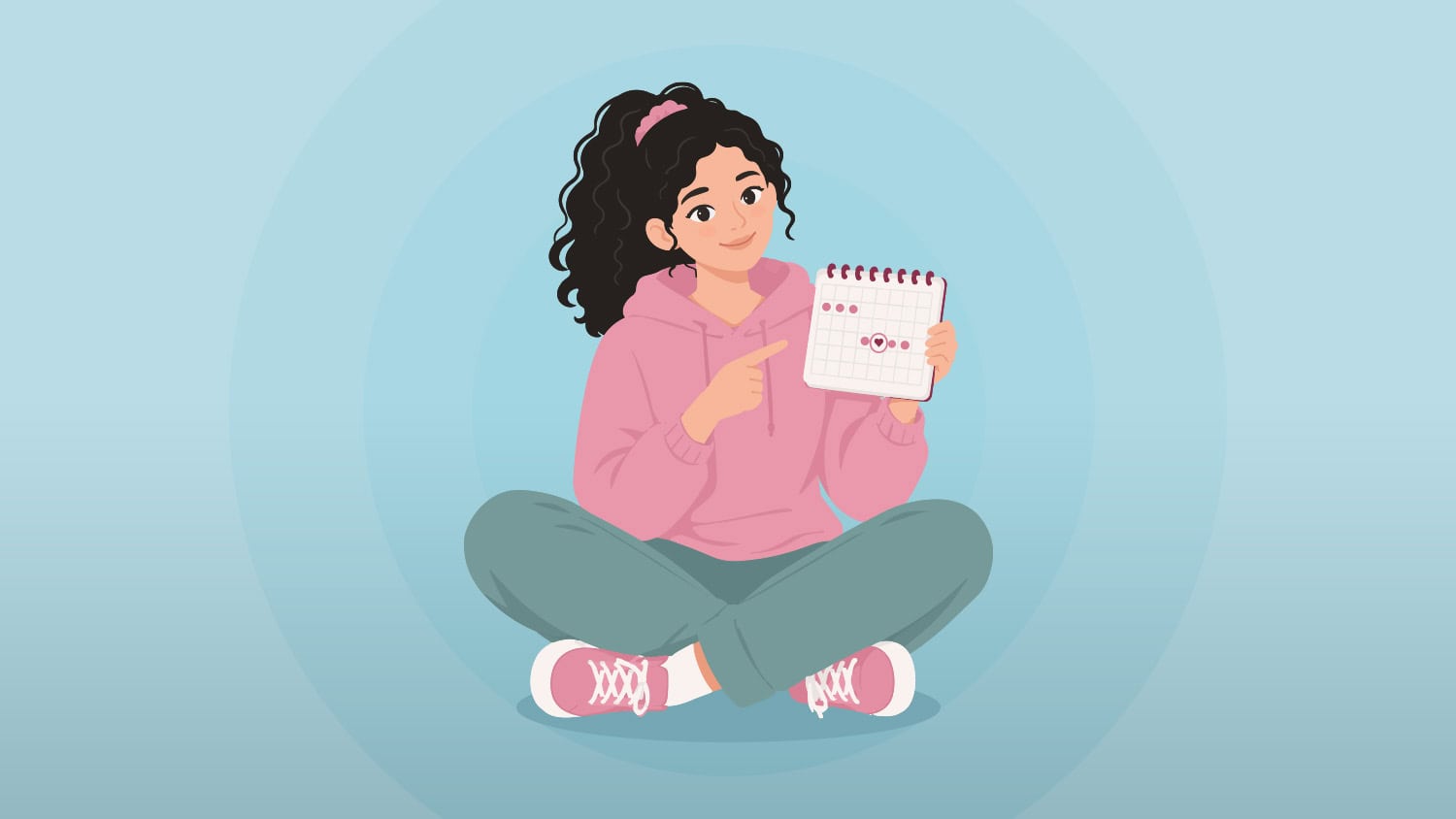
Help her track the first day of bleeding on a paper calendar or in a notebook. She doesn’t need a phone app to track her cycle. The goal is just to observe her patterns, not anticipate bleeding on the same day each month.
Which period products should she learn about?
Let her handle an unopened pad, see where the adhesive goes, and practice attaching one to underwear. Explain that there are several options, and she can choose what feels comfortable as she gains experience.3
| Product | What your daughter should know |
| Disposable pads | Sticks to underwear and collects blood outside the body. They are often convenient for a first period. |
| Period underwear | Looks like underwear but has an absorbent layer. Follow the washing instructions and change when needed. |
| Tampons | Go inside the vagina to absorb blood. Insertion should not be painful, and correct use is important. |
| Menstrual cups | Sit inside the vagina and collect blood. Learning to insert and clean one may take practice. |
How should she keep herself clean and comfortable?
Good menstrual hygiene keeps her comfortable. Teach her to wash her hands before and after changing a pad or tampon. Products should be changed whenever they feel full or wet. Wrap used pads in toilet paper and put them in the trash. Never flush them. Wash only the outside (the vulva) with warm water. The vagina cleans itself, so skip scented products.4
Tampons should be changed every 4 to 8 hours and never left in longer than 8 hours. She should choose the lowest absorbency that manages her flow. Explain that toxic shock syndrome (TSS) is rare but serious. Warning signs are sudden fever, vomiting, a rash, or feeling faint. If she has these while using a tampon, she needs urgent care.5
How can you prepare her for her first period at school?
Help her make a plan for handling a period at school on her own. Assemble a discreet pouch with two pads, extra clean underwear, a couple of tissues, and a resealable bag to hold dirty clothes. Let your daughter choose the pouch so she feels comfortable carrying it.
Rehearse a real-life scenario: “If you see blood in school, what might you do?” She could go to the bathroom and put on a new pad. She could also ask the school nurse, a teacher, or a trusted friend for one. Decide with her who she is comfortable asking and how you can be reached in an emergency.
At many U.S. schools, the nurse’s office may have spare pads, although availability varies. Help her find the nurse’s office. Where school rules permit, she can also keep an extra pad in her locker or gym bag for after gym class.
You can also explain that blood occasionally leaks onto clothes or bedsheets and that this is a practical problem, not something to be ashamed of. Show her how to rinse stains with cool water. If she calls you feeling upset, respond to her immediate need for supplies or a change of clothing before discussing anything else.
What if she has cramps or she worries about her body?
Some girls experience lower-belly pain or backaches, tender breasts, nausea, or headaches before or during their periods. Cramps happen partly because the uterus contracts, or tightens, as the lining sheds. A heating pad on a low setting, gentle movement, or rest can help. Over-the-counter pain relievers, such as ibuprofen, may also help. Check the label for her age and weight, and ask her doctor or pharmacist if you’re unsure.6
Don’t tell her periods never hurt, and don’t scare her either. Say that some people get cramps and that help is available. Don’t expect her to put up with every cramp. Any period that’s bad enough to interfere with school, sleep, sports, or day-to-day life is reason to consult a doctor.6
A first period doesn’t mean she is an adult or ready for sex. It is a normal part of growing up. As she gets older, talk with her about pregnancy and consent (her right to say yes or no). Tell her which trusted adults she can go to with questions.
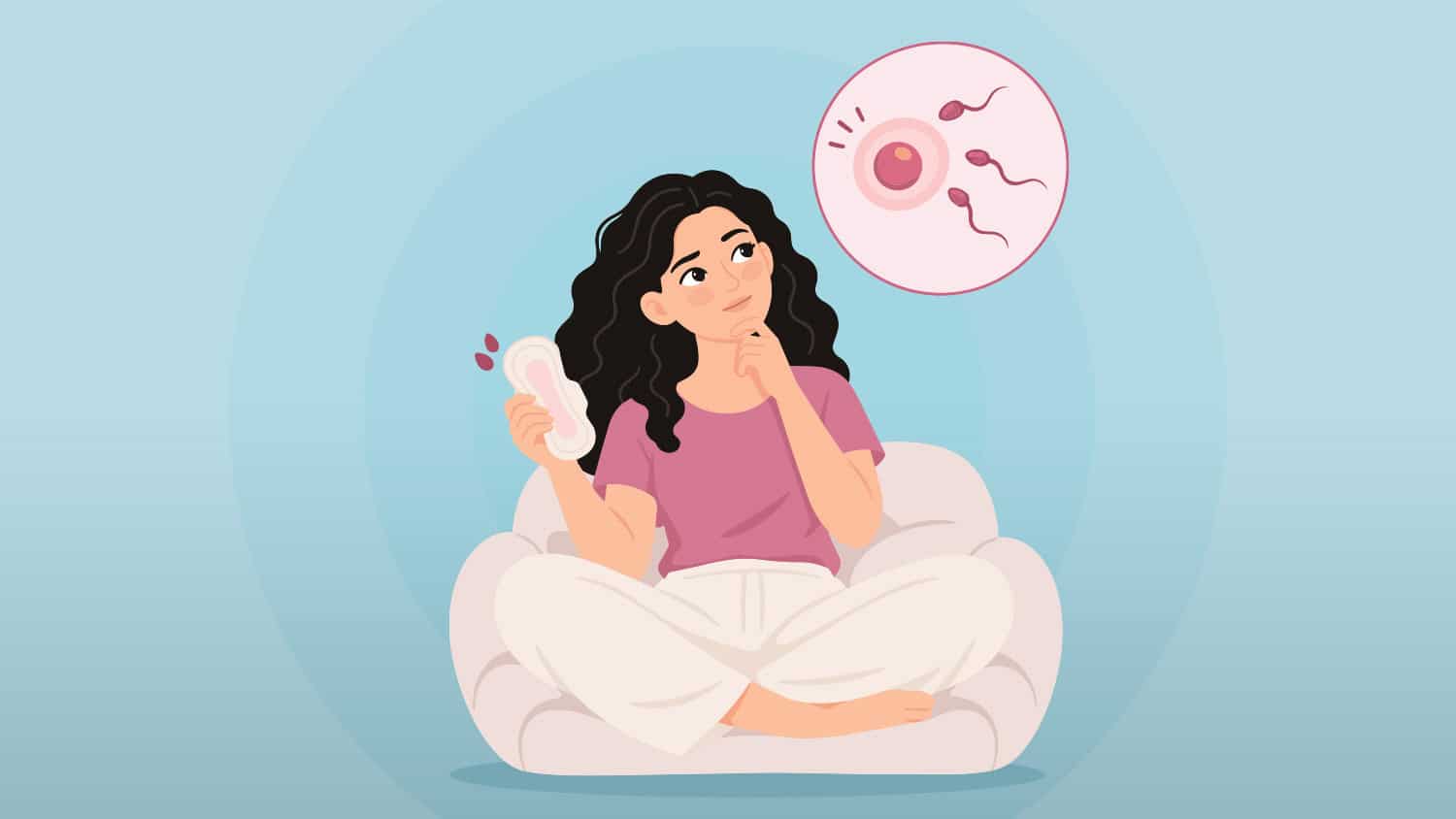
Explain that pregnancy is possible even before her first period because ovulation (when an ovary releases an egg) can happen first. Pregnancy may occur if sperm fertilizes that egg.7
What questions might your daughter be afraid to ask?
Sometimes the questions that sound small to adults are the ones children hesitate to say aloud.
| Her question | A helpful response |
| “Will everyone know I’m on my period?” | “No. It’s private, and you can decide who you want to tell.” |
| “What if I get blood on my clothes?” | “We’ll help you change and clean them. Leaks happen, and you won’t be in trouble.” |
| “Why did my friend get hers before me?” | “Bodies develop at different times. We can talk to a doctor if you’re worried about your timing.” |
| “Does this mean I’m grown up?” | “It means your body is changing. You still get to be a kid.” |
| “Will it hurt?” | “Some people get cramps. A heating pad or rest often helps, and we can see a doctor if it’s too much.” |
| “Is this much blood normal?” | “It can look like a lot, but the amount varies. If you need a new pad or tampon every 1 to 2 hours, we’ll call the doctor.” |
Leave some room for silence after answering. Children sometimes need time before they reveal the question they were really trying to ask.
When to see a doctor?
Most first periods don’t require an urgent appointment, but your daughter should know that menstrual symptoms can sometimes need evaluation. A doctor can help distinguish expected changes from a problem. Heavy bleeding, for example, can sometimes contribute to anemia (a shortage of healthy red blood cells), and in some adolescents it can signal a bleeding disorder.8 Arrange an appointment if your daughter:
- Has not had her first period by age 15, or within three years of the start of breast development.9
- Goes more than 90 days between periods after menstruation has begun.9
- Repeatedly has cycles shorter than 21 days or longer than 45 days.39
- Needs a new pad or tampon every 1 to 2 hours, bleeds for more than 7 days, passes blood clots larger than a quarter, or often feels exhausted or dizzy during periods.310
- Has cramps or other symptoms that repeatedly interfere with school, sleep, or daily life.
These patterns deserve assessment.389 The American College of Obstetricians and Gynecologists (ACOG) recommends a first reproductive health visit between ages 13 and 15. The visit may focus on questions and conversation. Most girls do not need a pelvic exam (an examination of the reproductive organs) at a first appointment.12
Seek emergency care if:
- She is soaking through one or more pads or tampons every hour for more than two hours in a row.
- She has heavy bleeding with dizziness or lightheadedness, shortness of breath, or chest pain.11
- She has a sudden high fever, vomiting or diarrhea, a rash that looks like sunburn, or feels faint while using a tampon or soon after. Take the tampon out first.5
Tell her that if no adult is around, she can call 911 herself.
Frequently asked questions
Don’t force a long conversation. Offer a short, age-appropriate book or a reliable health resource, tell her where the supplies are kept, and let her know she can return with questions. She may feel more comfortable speaking while doing another activity.
Yes. A calm, informed father, grandparent, or other caregiver can explain menstruation and help with supplies. What matters is that the child has someone she trusts who responds respectfully and can help her access medical care if needed.
Generally, yes, if she feels comfortable. A tampon, menstrual cup, or purpose-made period swimwear may be more suitable than a pad in a pool. She can also choose not to swim. Her participation shouldn’t be restricted by embarrassment or pressure.
Having a first period doesn’t automatically rule out tampon use. She should want to try them, understand the instructions, and be comfortable with insertion and removal. She can choose pads or period underwear instead; there is no need to rush.
Let her feel different materials and practice in a calm, private setting. Soft period underwear or a different pad shape may feel better than a product she finds irritating. Collaborate with her on a routine that she can follow independently or with help.
Last medically reviewed on
References
Our commitment to accuracy is paramount; we use high-quality sources, including peer-reviewed studies, to support the facts in our articles. Learn more about our Editorial Process.
- American College of Obstetricians and Gynecologists (ACOG). The top 3 questions parents ask about their daughters and puberty. (Published: October 2020; Last reviewed: September 2026). acog.org
- American College of Obstetricians and Gynecologists (ACOG). Your changing body: puberty in girls. (Last updated: June 2022; Last reviewed: November 2025). acog.org
- American College of Obstetricians and Gynecologists (ACOG). Your first period. (Last updated: June 2022; Last reviewed: November 2025). acog.org
- Centers for Disease Control and Prevention (CDC). Menstrual hygiene. (Last reviewed: May 7, 2024). cdc.gov
- U.S. Food and Drug Administration (FDA). The facts on tampons and tampon safety. (Content current as of: September 15, 2026). fda.gov
- American College of Obstetricians and Gynecologists (ACOG). Painful periods. (Published: October 2020; Last reviewed: May 2026). acog.org
- Planned Parenthood. Can a female who has never had a menstrual cycle get pregnant? (Date shown: Sept. 7, 2011; no update or review date displayed). plannedparenthood.org
- American College of Obstetricians and Gynecologists (ACOG). Screening and management of bleeding disorders in adolescents with heavy menstrual bleeding. ACOG Committee Opinion No. 785. Obstet Gynecol. 2019;134(3):e71–e83. doi.org
- American College of Obstetricians and Gynecologists (ACOG). Menstruation in girls and adolescents: using the menstrual cycle as a vital sign. ACOG Committee Opinion No. 651. Obstet Gynecol. 2015;126(6):e143–e146. doi.org
- American College of Obstetricians and Gynecologists (ACOG). Heavy menstrual bleeding. (Last updated: May 2021; Last reviewed: May 2026). acog.org
- American College of Obstetricians and Gynecologists (ACOG). Abnormal uterine bleeding. (Last updated: December 2021; Last reviewed: August 2025). acog.org
Update history
Our team monitors the health and wellness space to keep articles current.
Current version (October 26, 2026) — Medically reviewed by Dr. Sadaf Iftikhar, MBBS, FCPS. Written by Dr. Aqsa Munir, MBBS.