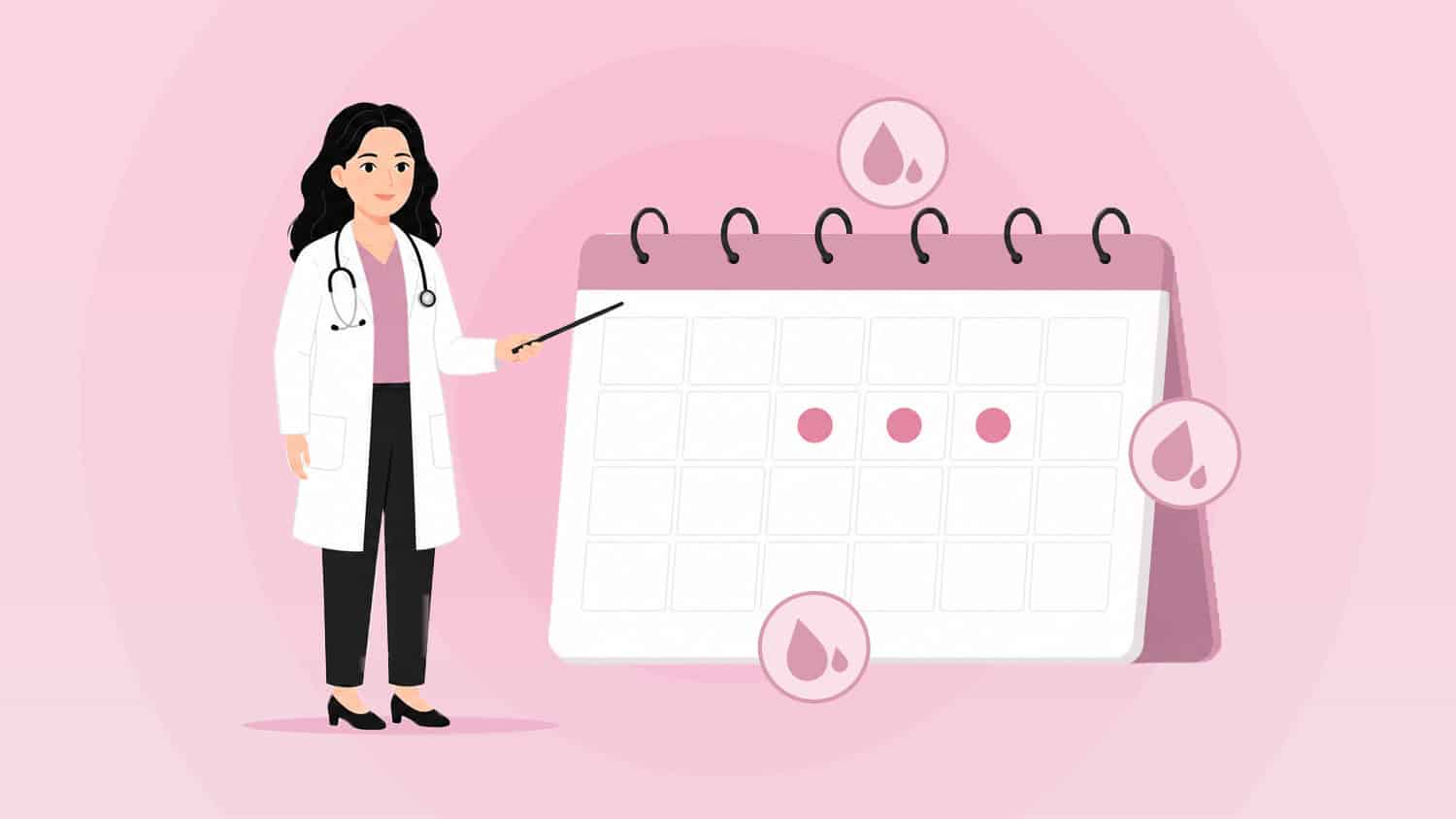
A little unpredictability in your cycle is normal, and often it’s just your body responding to something ordinary, like stress, a new medication, poor sleep, the first couple of years after your first period, or the years leading into menopause. Doctors consider a cycle irregular when it falls outside 24 to 38 days apart, when bleeding lasts longer than 7 days, or when the pattern itself feels unpredictable from month to month.12
On this page
- What does a normal period actually look like?
- What’s normal at different life stages?
- How are the causes of irregular periods classified now?
- What’s actually behind an irregular period?
- What can untreated irregular periods do over time?
- Can you still get pregnant with irregular periods?
- Getting to a diagnosis
- What are the treatment options?
- When to see a doctor?
Key takeaways
- A cycle can vary and still be normal: 24 to 38 days apart and 2 to 7 days of bleeding for most adults, with a wider range for teenagers just starting their periods.
- Doctors now use the term Abnormal Uterine Bleeding (AUB), classified with the PALM-COEIN system, instead of older words like “menorrhagia”.
- Causes range from puberty, perimenopause, PMOS, thyroid disorders, medications, and stress to big changes in weight or exercise.
- Diagnosis usually starts with a detailed medical history and, if needed, a blood test or pelvic ultrasound.
- Treatment depends on the cause; some of the options are lifestyle changes, hormonal therapy, and targeted medication.
- Trying to conceive with an irregular cycle takes more patience, but it doesn’t mean pregnancy is not possible.
- See your OB-GYN for sudden changes, very heavy or prolonged bleeding, periods absent for three months or more, or any bleeding after menopause.
- Irregular periods can quietly affect iron levels, bone health, and fertility if they’re left untreated.
What does a normal period actually look like?
For most adults, a typical menstrual cycle, counting from day one of one period to the first day of the next, falls between 24 and 38 days. The bleeding usually lasts 2 to 7 days, and total blood loss over one period is between 5 and 80 milliliters, or roughly one to five tablespoons.1 You may also see a 21-to-35-day range in older sources; 24 to 38 days is the range doctors currently use to define abnormal bleeding. This is often measured by how often you had to change your pad, tampon, or menstrual cup/disk.
| Life stage | Cycle Length | Bleeding days | What to expect? |
| First 1–3 years after first period | 21 to 45 days | Up to 7 | 60–80% settle into 21–34 days by 3rd year |
| Adults | 24 to 38 days | 2 to 7, up to 8 | Should be fairly predictable |
| Perimenopause | Variable | Variable | Irregularity is expected |
| After menopause | No bleeding at all | – | Any bleeding needs evaluation |
What’s normal at different life stages?
At teenage
If you’re a teenager, the range is naturally wider. In the first few years after menarche (the medical term for when periods start), it’s common for cycles to range from 21 to 45 days, last up to 7 days, and require changing a pad or tampon 3 to 6 times a day.34 This is because the communication between your brain and your ovaries is not properly established yet. This is known as the hypothalamic-pituitary-ovarian axis; by about the third year after your first period, roughly 60% to 80% of cycles settle into the 21-to-34-day adult range on their own.3
If you’re a parent or caretaker and a teenager mentioned irregular periods, some irregularity in the first and third year is expected. However, if something feels extremely off, consult an OB-GYN right away.
The American College of Obstetricians and Gynecologists, the leading US professional body for women’s health, recommends that clinicians ask about a teenager’s period at every checkup, treating it like a vital sign, the same way they’d check blood pressure or pulse.3 That’s a good habit to borrow at home too. Keeping a simple record of dates, flow, and any pain makes it much easier to identify any irregularity; using a period tracker is fairly easy and convenient.
Perimenopause
Perimenopause is the transition into menopause, and irregular periods are usually the first sign it’s begun. It typically starts in your 40s (occasionally as early as your mid-30s) and lasts an average of four years, though the timeline varies person to person.56 Cycles may start arriving closer together or further apart, and flow can feel lighter or heavier than what you’re used to. This is a normal part of estrogen and progesterone naturally shifting as ovulation becomes less frequent6; it’s not usually a sign that something’s wrong.
Still, it is important to check in with your OB-GYN if bleeding feels unusually heavy, happens after sex, or shows up again after a full year without a period.7
How are the causes of irregular periods classified now?
For a long time, doctors described period problems with a set of Latin-rooted terms, and you’ll still come across these in older articles and forums.89
- Amenorrhea: Periods have stopped completely.
- Primary amenorrhea is when a period hasn’t started by age 15 despite normal development.
- Secondary amenorrhea is no period for 3 months in someone whose cycles were previously regular, or 6 months in someone whose cycles were previously irregular.
- Oligomenorrhea: Infrequent periods, typically fewer than nine cycles a year or cycles longer than 35 days.
- Polymenorrhea: Periods that come too often, with cycles shorter than 21 days.
- Menorrhagia: Heavy or prolonged bleeding during a period.
- Metrorrhagia: Irregular bleeding or spotting between periods.
In 2011, the International Federation of Gynecology and Obstetrics (FIGO) introduced a clearer system, and ACOG has been using it across the US since then.810 The new umbrella term is abnormal uterine bleeding (AUB): any uterine bleeding that is abnormal in frequency, regularity, duration, or volume, outside of pregnancy.9 Causes are then sorted under one acronym, PALM-COEIN.8
PALM
Covers structural causes, things a scan or biopsy can detect.
- A polyp is a small benign growth.
- Adenomyosis is uterine-lining tissue growing into the uterine muscle wall.
- Leiomyoma, more commonly called a fibroid, is a noncancerous muscle growth in the uterus.
- Malignancy or hyperplasia refers to uterine cancer or an overgrown uterine lining, both uncommon but important to rule out.
COEIN
Covers the causes that aren’t structural.
- Coagulopathy is a blood-clotting disorder, such as von Willebrand disease.
- Ovulatory dysfunction means irregular or absent ovulation, the release of an egg from the ovary, and it’s the most common cause overall.
- Endometrial refers to a problem local to the uterine lining itself.
- Iatrogenic means caused by a medication or medical device, such as certain birth control methods or blood thinners.
- Not otherwise classified refers to any cause that doesn’t fit anywhere else.
What’s actually behind an irregular period?
Honestly? A lot of things, ranging from completely benign to ones that need real treatment. Here’s a breakdown:
Life stage
In the first year or two after your first period, cycles are often irregular because the brain-ovary connection is still maturing. The same happens during perimenopause, the years before menopause, when estrogen and progesterone naturally fluctuate, causing the periods to become shorter, longer, heavier, lighter, or stop altogether.567 Pregnancy stops periods entirely; unexpected bleeding when pregnancy is possible should be addressed immediately.
Hormones and underlying conditions
PCOS (Polycystic Ovary Syndrome) now known as PMOS (Polyendocrine Metabolic Ovarian Syndrome),1112 thyroid disorders, (Primary Ovarian Insufficiency) POI (when the ovaries stop working normally before age 40), structural issues like polyps or fibroids, endometriosis, pelvic inflammatory disease, uncontrolled diabetes, bleeding disorders like von Willebrand disease,4 eating disorders, and, rarely, uterine or ovarian cancer can all disrupt your cycle. If any of this sounds familiar, reach out to your physician; asking for help is a strength, not a failure.
Medications and birth control
Hormonal birth control commonly causes spotting in the first few months, which is often harmless. Certain other medications, including some antipsychotics, anti-seizure drugs, blood thinners, and steroids, can affect your cycle too.
Sexually transmitted infections
Certain infections can also cause irregular periods. Chlamydia and gonorrhea can inflame the cervix, often causing bleeding between periods or after sex. These infections don’t always come with other symptoms, so testing is the only way to know for sure and both can be successfully treated once diagnosed.13
Everyday life
Stress, rapid weight changes, intense exercise, poor sleep, and inconsistent nutrition can all throw off the hormonal signals that keep your cycle regular. None of this means you’re doing something wrong.14
What can untreated irregular periods do over time?
Occasional irregularities rarely cause lasting harm. But when heavy, prolonged, or absent periods continue for months without any treatment, a few things can happen quietly in the background.
- Ongoing heavy or prolonged bleeding can lead to iron-deficiency anemia, showing up as fatigue, dizziness, or shortness of breath.15
- Irregular or absent ovulation, common in PMOS and other hormonal imbalances, can make conceiving harder until the cause is treated.
- Estrogen also helps protect bone density, so conditions that lower estrogen for a long duration, like primary ovarian insufficiency or prolonged amenorrhea, can raise the risk of weaker bones over time.
- When ovulation doesn’t happen regularly, the uterine lining can build up without its usual monthly shedding, which can raise the risk of changes in the lining, a condition called endometrial hyperplasia.1 This needs regular monitoring.
Can you still get pregnant with irregular periods?
If you’re planning to conceive, irregular cycles can make timing trickier, mainly because they make it harder to predict ovulation and pinpoint your fertile window. Conditions like PMOS or thyroid disorders can also reduce how often ovulation happens at all, which lowers the number of chances for conception across a year. If you do become pregnant with irregular periods, your care team may rely more on ultrasound dating than your last period date to track how far along you are.
None of this means pregnancy isn’t possible. For a majority of people with irregular periods, it is. It usually just means an appointment with your doctor or a fertility specialist can help you understand your particular pattern and provide support, if needed.
Getting to a diagnosis
Your doctor will likely ask about your cycle history, family history, medications, stress levels, weight changes, and any other symptoms. Based on your history, they may recommend:
- Pregnancy test: Your doctor will first rule out pregnancy.
- Blood tests: Checking hormones like TSH (thyroid-stimulating hormone), prolactin, FSH and LH (follicle-stimulating and luteinizing hormone, which drive ovulation), and testosterone, plus a complete blood count to check for anemia.16
- Pelvic ultrasound: A non-invasive imaging test that can spot fibroids, polyps, or ovarian cysts; in teenagers, structural causes are rare, so ACOG states that a routine ultrasound often isn’t necessary unless symptoms don’t improve with initial treatment.4
- Endometrial biopsy: A small tissue sample from the uterine lining, recommended at age 45+, or under 45 with risk factors (unopposed estrogen exposure, obesity, PMOS, persistent bleeding, failed medical management)
- Hysteroscopy: A thin, lighted scope used to look inside the uterus directly, typically used when imaging suggests a polyp or fibroid that needs closer evaluation or removal.
What are the treatment options?
Treatment depends entirely on the cause.
Lifestyle changes
Maintaining a healthy weight, a balanced diet, moderate exercise, consistent sleep, and stress management, especially for lifestyle- or weight-related causes.
Hormonal therapy
Birth control pills, the patch, the ring, or progestin-only options like pills, injections, or a hormonal IUD, to regulate cycles and reduce heavy bleeding.
Targeted medications
- The levonorgestrel IUD (Mirena, Liletta) is first-line medical therapy for heavy menstrual bleeding
- Two oral combination medications, Oriahnn (elagolix, estradiol, norethindrone acetate), approved in 2020, and Myfembree (relugolix, estradiol, norethindrone acetate), approved in 2021, are FDA-approved specifically for heavy menstrual bleeding caused by uterine fibroids, for use up to 24 months1718
- Tranexamic acid for heavy bleeding
- NSAIDs (ibuprofen, naproxen), which are a first step for mild to moderate heavy bleeding19
- Antibiotics for pelvic inflammatory disease
- Thyroid medication for a thyroid disorder20
- In case of anemia, your doctor may prescribe oral or intravenous iron, alongside addressing the cause
Procedures for structural causes
- Myomectomy (removes fibroids)
- Dilation and Curettage (D&C) (removes lining tissue)
- Endometrial ablation (removes the lining)
- Hysterectomy (removes the uterus), usually a last resort
When to see a doctor?
Some irregularities are simply due to minor lifestyle changes. Reach out to a doctor if you notice:
- An unexplained change in a previously regular cycle
- Cycles shorter than 24 days or longer than 38 days as an adult (or shorter than 21 or longer than 45 as a teenager)14
- Bleeding that lasts more than 7 days, or having to change a pad or tampon hourly
- No period for three months or more, without pregnancy, breastfeeding, or menopause
- Bleeding between periods or after sex
- Severe pain with nausea or vomiting
- Any bleeding after menopause is confirmed (12 months period-free)7
- Signs of anemia: fatigue, dizziness, shortness of breath
- Trouble conceiving after months of trying, with irregular cycles
If you’re a teenager and experience any of this or something else entirely, it’s completely reasonable to keep your parents or caretaker in the loop. And equally reasonable to ask for privacy with your OB-GYN if that feels comfortable.
When to seek emergency care
- Soaking through two or more pads or tampons an hour, for two hours or more in a row
- Passing clots larger than a quarter along with heavy, ongoing bleeding
- Bleeding that will not stop and is soaking through your clothes
- Bleeding along with dizziness, fainting, a racing heartbeat, or trouble breathing
- Sudden, severe one-sided pelvic pain, especially if pregnancy is possible
Frequently asked questions
Very much so. It’s common for cycles to be unpredictable for the first one to two years after your first period, while your body adapts to the changing hormonal levels.
Not necessarily. Many people with irregular periods conceive without any intervention. However, it does mean ovulation can be unpredictable, so tracking your cycle and working with your OB/GYN can help improve your chances of a better outcome.
No single food reliably regulates periods on its own. If a nutritional deficiency or significant weight change is contributing to irregularity, then taking a balanced diet may help regulate your cycle.
Not really, unless your cycles were always irregular or you’re pregnant, breastfeeding, or in perimenopause. It’s important to visit your OB-GYN to check for an underlying cause.
No. Most causes are benign and very treatable. Doctors still recommend evaluation because a small number of causes, like certain structural changes or, rarely, cancer, are much easier to manage the earlier they’re found.
Yes, it can. Stress can disturb the hormone signals that control your cycle, sometimes pausing your period completely. It usually comes back once the stress eases up.
Yes, very common. Your body needs a little time to find its own rhythm again. For most people, things settle within a few months. If it’s still irregular after that, mention it to your OB-GYN at the next visit.
Not usually; there are other common reasons for irregular periods. But if you’re under 40 and also having hot flashes or missed periods, it’s worth asking your doctor about it.
Sometimes, if weight was part of the cause. Reaching a stable, healthy weight can help your cycle settle down. But if something like PMOS or a thyroid issue is also involved, weight change alone might not be enough.
It depends on your state’s laws. Many doctors will also see teens with a parent for part of the visit, then offer some private time to talk about anything sensitive.
Last medically reviewed on
References
Our commitment to accuracy is paramount; we use high-quality sources, including peer-reviewed studies, to support the facts in our articles. Learn more about our Editorial Process.
- StatPearls, National Library of Medicine (NIH). Abnormal Uterine Bleeding. ncbi.nlm.nih.gov
- Munro MG, Critchley HOD, Fraser IS; FIGO Menstrual Disorders Committee. The Two FIGO Systems for Normal and Abnormal Uterine Bleeding Symptoms and Classification of Causes of Abnormal Uterine Bleeding in the Reproductive Years: 2018 Revisions. Int J Gynaecol Obstet, 2018 pubmed.ncbi.nlm.nih.gov
- American College of Obstetricians and Gynecologists. Committee Opinion No. 651: Menstruation in Girls and Adolescents: Using the Menstrual Cycle as a Vital Sign. Obstet Gynecol, 2015 (reaffirmed 2025). acog.org
- American College of Obstetricians and Gynecologists. Committee Opinion No. 785: Screening and Management of Bleeding Disorders in Adolescents With Heavy Menstrual Bleeding. Obstet Gynecol, 2019. acog.org
- American College of Obstetricians and Gynecologists. Perimenopausal Bleeding and Bleeding After Menopause. acog.org
- Office on Women's Health, U.S. Department of Health and Human Services. Menopause Symptoms and Relief. womenshealth.gov
- National Institute on Aging, National Institutes of Health. What Is Menopause? nia.nih.gov
- Munro MG, Critchley HOD, Fraser IS, for the FIGO Working Group on Menstrual Disorders. FIGO Classification System (PALM-COEIN) for Causes of Abnormal Uterine Bleeding in Nongravid Women of Reproductive Age. Int J Gynaecol Obstet, 2011. pubmed.ncbi.nlm.nih.gov
- American Academy of Family Physicians. Abnormal Uterine Bleeding in Premenopausal Women. Am Fam Physician, 2019. aafp.org
- American College of Obstetricians and Gynecologists. Practice Bulletin No. 128: Diagnosis of Abnormal Uterine Bleeding in Reproductive-Aged Women. Obstet Gynecol, 2012 (reaffirmed 2024). acog.org
- Polyendocrine metabolic ovarian syndrome, the new name for polycystic ovary syndrome: a multistep global consensus process. The Lancet. Published online May 12, 2026. thelancet.com
- Eunice Kennedy Shriver National Institute of Child Health and Human Development (NICHD). What are menstrual irregularities? nichd.nih.gov
- StatPearls, National Library of Medicine (NIH). Cervicitis. ncbi.nlm.nih.gov
- Office on Women's Health, U.S. Department of Health and Human Services. Period Problems. womenshealth.gov
- National Heart, Lung, and Blood Institute, National Institutes of Health. Iron-Deficiency Anemia. nhlbi.nih.gov
- Sweet MG, Schmidt-Dalton TA, Weiss PM, Madsen KP. Evaluation and Management of Abnormal Uterine Bleeding in Premenopausal Women. Am Fam Physician, 2012. aafp.org
- U.S. Food and Drug Administration. Oriahnn (elagolix, estradiol, and norethindrone acetate capsules) Prescribing Information. Approved May 2020. accessdata.fda.gov
- U.S. Food and Drug Administration. Myfembree (relugolix, estradiol, and norethindrone acetate) Prescribing Information. Approved May 2021. accessdata.fda.gov
- Bofill Rodriguez M, Lethaby A, Farquhar C. Non-steroidal anti-inflammatory drugs for heavy menstrual bleeding. Cochrane Database of Systematic Reviews, 2019. cochranelibrary.com
- American College of Obstetricians and Gynecologists. Committee Opinion No. 557: Management of Acute Abnormal Uterine Bleeding in Nonpregnant Reproductive-Aged Women. Obstet Gynecol, 2013 (reaffirmed 2024). acog.org
Update history
Our team monitors the health and wellness space to keep articles current.
Current version (July 25, 2026) — Medically reviewed by Dr. Sadaf Iftikhar, MBBS, FCPS.
August 11, 2023 — Medically reviewed by Dr. Sadaf Iftikhar, MBBS, FCPS. Written by Dr. Ramisha Farooq, MBBS.