Your son finds a packet of pads in the bathroom and asks, “What are these for?” Or he comes home from school and repeats a joke about periods he heard that day. You want to do a good job, but you’re unsure how much he needs to know or where to start.
While most parents already talk to their daughters about periods, not all are discussing it with their son. But boys want to know about periods too. Talking about periods to your son helps him to better understand how bodies work and treat others with consideration.
The conversation doesn’t need to be awkward or uncomfortable. You only need to help your son understand periods as a natural part of human biology.
On this page
- How can you explain a period to your son?
- Why is it important to teach boys about periods?
- When should you start talking to your son about periods?
- How can you start the conversation naturally?
- Can dads and single parents talk to their sons about periods?
- What does your son need to learn about periods?
- How can you relate periods to your son’s own puberty?
- How can you teach your son empathy and respect?
- How should you respond to awkward or difficult questions?
- Common period myths (and what’s true)
Key takeaways
- Help your son understand periods so he can be kind and respectful to the people around him.
- Start with basic, age-appropriate facts, and teach him more as he gets older.
- Use correct words, answer his questions calmly, and invite him to keep asking.
- Teach him that periods aren’t embarrassing and that teasing about them is never okay.
- Show him how to respect privacy and how to offer support.
How can you explain a period to your son?
A period, also known as menstruation, is when blood and tissue from the lining of the uterus (the organ where a baby grows during pregnancy) leave the body through the vagina (the passage from the uterus to the outside of the body). This process is controlled by hormones, which are chemicals the body makes to help organs work. Cycles are often about a month long, but the length varies.1
You might not want to go into all of the anatomy when talking to a small boy. You might want to start with:
“Inside a girl’s body there’s an organ called the uterus. During puberty, her body starts getting ready for a possible pregnancy someday. Each cycle, the uterus builds a soft lining. If there’s no pregnancy, the body sheds the lining as blood and tissue. That’s a period.”
When he’s older, you can explain that the ovaries release an egg each month (ovulation), and that pregnancy can happen if a sperm joins with that egg (fertilization).
Menstrual bleeding is not an injury, and it does not mean someone is sick.
Why is it important to teach boys about periods?
Your child may have heard period-related comments, jokes, misinformation, or embarrassing situations at school. Your child may feel confused, spread false information, or make hurtful comments without knowing the effects of what they’re saying.
The Centers for Disease Control and Prevention (CDC) emphasizes that developmentally appropriate health education should help young people understand their bodies, communicate respectfully, and develop healthy relationships.2
Understanding menstruation can help your son recognize that:
- Menstruation is a normal part of the human body; nothing is embarrassing about it.
- Some people can experience quite a bit of pain and other symptoms while having their period.
- Personal information about someone’s period deserves privacy.
- Being supportive does not require making assumptions or drawing attention to someone.
These lessons are suitable whether he is interacting with classmates, siblings, friends, or future partners.
When should you start talking to your son about periods?
You can start to introduce the topic of periods and menarche as early as childhood, with the language that is right for your son. There’s no need to wait until puberty or until he asks a question.
The American Academy of Pediatrics (AAP) recommends answering children’s questions about their bodies, using appropriate anatomical terms and age-appropriate information.3
| Your son’s age | What you can teach him | Try saying |
| 4–7 years | Introduce the word “period” and explain that some bodies release a little blood regularly as a natural process. | “Some girls and women bleed a little every month. It’s normal, and it’s called a period.” |
| 8–11 years | Explain the uterus, menstrual bleeding, and puberty. Discuss pads and other products, privacy, and respectful behavior. | “Each month a girl’s uterus builds a soft lining. If there’s no pregnancy, it leaves the body as blood. That’s a period.” |
| 12–15 years | Explore the menstrual cycle, reproduction, common symptoms, myths, and practical ways to support others. | “Cycles vary, and cramps are common. Let’s talk about how to be kind and respectful.” |
| 16 years and older | Discuss menstrual health within broader conversations about reproductive health, consent, empathy, and relationships. | “Respect and consent apply to how we talk about bodies and periods.” |
Age ranges are general guidance, and every child is different. The AAP notes that school-age children often ask, What is a periods3
Some children are ready to talk about these subjects much earlier, while others may need more time.
The average age of girls getting their periods is 12 to 13, although some begin earlier or later.4 A girl should see a doctor if her period starts before age 8 or has not started by age 15.14 Talking early helps him understand what classmates may be going through.
How can you start the conversation naturally?
Sometimes, the most comfortable moments to talk about menstruation are in informal conversations. It is easier to talk in a relaxed setting, where your son can ask questions without feeling tested or judged.
Use everyday situations
Maybe your son sees you buying pads, notices a period-product ad, or asks why his sister needs a heating pad. Use that moment to give a simple, honest answer.
For example, if he asks why you buy pads, you might respond:
“Pads absorb menstrual blood during a period. They’re something many girls and women use to stay comfortable and manage bleeding.”
An answer like this provides useful information without making the subject feel unusually serious.
Ask what he already knows
Some older kids might have a bit of knowledge about periods from other children, school, or even social media. Ask before you tell them the whole story:
“Did you get any information about periods at school?”
His reply can point out any gaps or misconceptions and assist you in choosing which information would be most relevant. If he tells you something inaccurate, correct it without berating him for believing it.
Use the correct words
Use real words like period, uterus, vagina, and ovaries, and explain them in simple terms. Avoid vague phrases like “women’s problems” or “that time of the month.” They can make periods feel shameful or mysterious.3
Make him comfortable asking questions
Your son might ask one question and then try to move on from the subject right away. That’s okay.
You don’t need to cover it all at once. Remind him he can always bring it up again if he has another question.
What does he learn at school?
Many U.S. schools teach puberty in upper elementary or middle school health class, but what’s covered depends on your state and school district. Ask your son’s school what the lessons include and when they happen. A growing number of states also require schools to stock free pads and tampons in student bathrooms, so he may see them at school.5
Can dads and single parents talk to their sons about periods?
Yes. Dads, single parents, and other trusted caregivers can explain periods, even if they do not menstruate themselves. A father might say, “I don’t have periods, but I can explain what happens and answer your questions.” The American Academy of Pediatrics (AAP) encourages parents to answer honestly and simply, and says it’s okay to admit when you feel uneasy. It suggests asking a relative, close family friend, or your pediatrician for help if needed.3 When fathers and other adults discuss periods without embarrassment or teasing, they show boys that menstruation is an ordinary health topic.
What does your son need to learn about periods?
Once your son understands the basic process, introduce a few practical facts that will help him recognize what menstruation actually involves.
Periods don’t happen on an exact schedule
It’s normal to have periods again and again in reproductive years, but they may not come on the same date each cycle.
In teen girls, cycles can be 21 to 45 days long, and bleeding usually lasts 2 to 7 days. Periods can be very irregular for the first few years after a girl’s first period.4 A cycle is counted from the first day of one period to the first day of the next.1
Your son doesn’t need to memorize these numbers. What matters is that he understands that not everyone has their period at the same time of the month and that you can’t always tell in advance when you’re going to start bleeding.
What are period products?
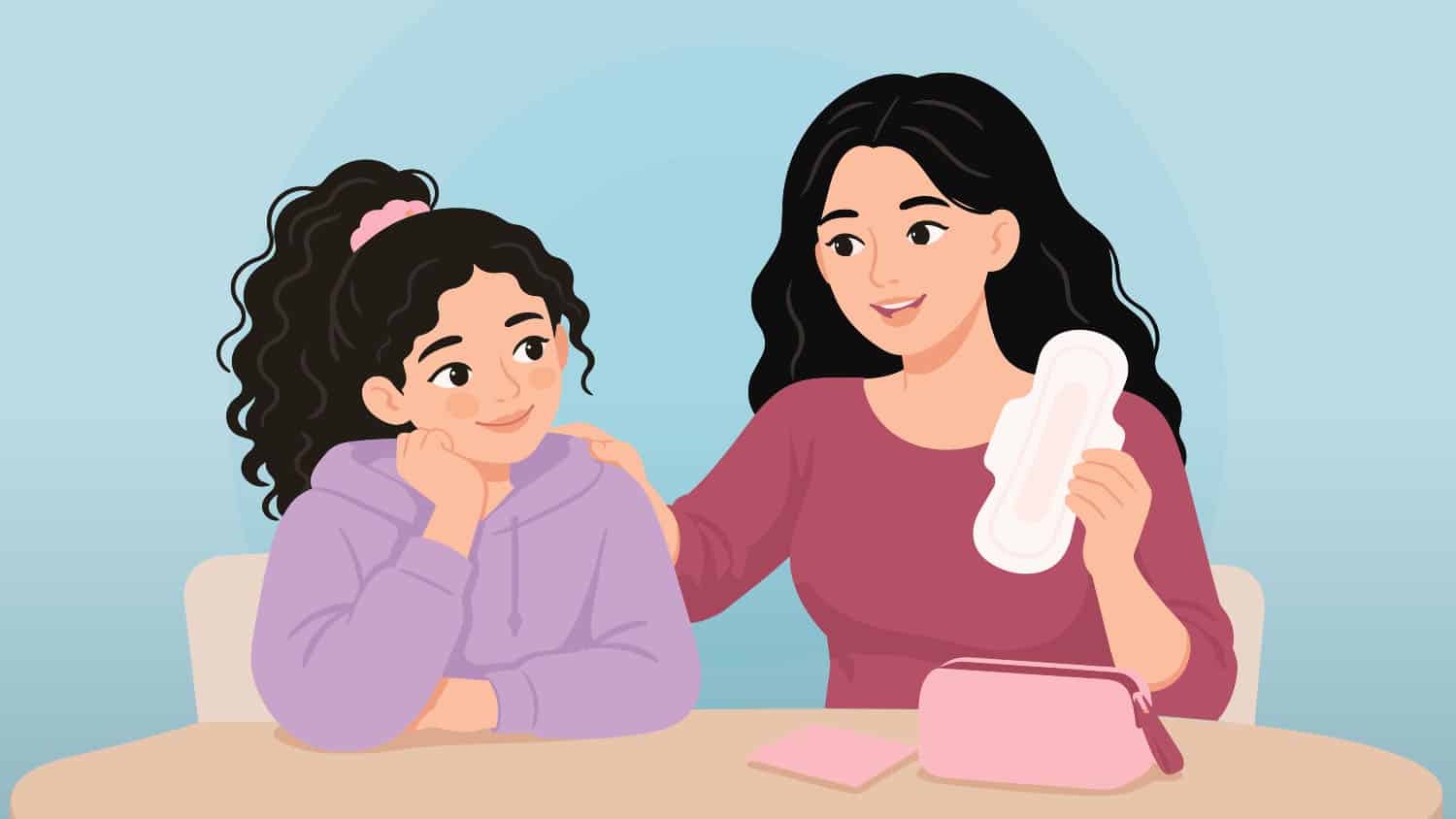
Talk to your son about a sanitary pad, show him one, and explain what it is for. At a suitable age, you could also introduce him to:
- Pads: Absorbent products worn inside underwear.
- Tampons: A small absorbent plug that is made to be placed into the vagina.
- Menstrual cups: These are temporary cups that are put into the vagina to gather the menstrual flow.
- Period underwear: Underwear that has been specifically manufactured to capture menstrual flow.
You might say: “People buy a variety of products for reasons of comfort, product preference, or just because they want to.” No need to keep period products a secret. They’re personal care items, like tissues or dental floss.
Some periods are uncomfortable
Periods are more than just bleeding. Girls may have cramps, headaches, nausea, fatigue, lower back pain, or their bowel movements might be different.
Menstrual cramps are caused in part by naturally occurring chemicals called prostaglandins, which make the uterus muscles contract. The pain can range from mild to severe and, in some cases, may be severe enough to disrupt school, sleep, or other activities.6
Tell your son that everyone’s experience is different. One friend might get through her game without a problem, while another friend might be in pain. Heat from a heating pad and gentle exercise can help ease cramps.7
How can you relate periods to your son’s own puberty?
Puberty brings changes to boys’ bodies too, including growth spurts, a deeper voice, and wet dreams (ejaculation during sleep).8 Girls go through puberty too, and starting their periods is one of the changes.7 You could say, “Your body changes as you grow, and other people’s bodies change too, although the changes are not the same.” This comparison helps your son understand puberty without suggesting that wet dreams and periods are the same biological process.
Puberty looks different for everyone, and it’s normal to feel curious or awkward about it.
How can you teach your son empathy and respect?
Many parents think teaching boys about periods is only about reproductive biology. It’s also a chance to teach empathy and respect.
Explain why period jokes can be hurtful
Give him a real-life example. Let’s suppose a girl in your class notices a stain on her pants. Her classmates notice and start laughing. Ask your son to imagine how she might be feeling.
Instead of just telling him it’s wrong to laugh, help him recognize the embarrassment someone may experience in public.
Try saying: “Periods are normal. No one should be embarrassed or teased because of one.”
Jokes about menstrual blood, soiled clothes, or sanitary products are only likely to make the situation worse.
The same applies online. If a friend posts a period joke in a group chat, your son does not have to lecture anyone; not replying, or saying “not funny,” is enough. Talk through what he could do before it happens, so he is not deciding in the moment.
Teach him to respect privacy
Periods are normal, but that doesn’t mean everyone is up for talking about their personal experience.
Teach him not to ask whether someone is on her period, announce it, or comment on her products, and teach him not to assume a period is the reason someone is upset or moody.
Ask him how to offer support
You don’t have to know what somebody’s going through to be kind.
If his sister has painful cramps, he can bring her a heating pad or take over one of her chores without being asked. A simple “Do you want anything?” is better than a joke or a question about what is wrong.
When a classmate unexpectedly needs a pad, you can subtly try to connect her with a friend, teacher, or school nurse.
The key takeaway is to ask what will help, not assume you know what someone needs. There are times when being supportive involves helping. Other times, it involves honoring a desire for privacy.
How should you respond to awkward or difficult questions?
Children often ask surprisingly direct questions about periods. Some may sound uncomfortable, but they usually reflect curiosity.
Here are a few ways to respond.
“Is period blood dirty?”
“No. Menstrual fluid contains blood and tissue from the uterus. It’s a natural bodily process, not a way for the body to remove dirt or toxins.”
“Does having a period hurt?”
“Some people have cramps or other symptoms, while others experience very little discomfort. Everyone’s experience can be different.”
“Why don’t boys have periods?”
“Boys don’t have a uterus, which is the organ involved in menstruation. Bodies have different reproductive organs.”
As your son matures, you can also explain that some transgender boys and nonbinary people menstruate, while not all women and girls have periods.
If he reacts by saying, “That’s disgusting,” resist the temptation to embarrass or scold him immediately.
You might respond:
“It might sound unfamiliar because you haven’t experienced it. But it’s a normal body process, and nothing is disgusting about someone having a period.”
This acknowledges his reaction while teaching him a more respectful perspective.
Common period myths (and what’s true)
Children often learn inaccurate information through friends, entertainment, or online content. When you address common period myths, you give your son a better understanding of menstruation.
If he hears something about periods online, ask, “Where did you see that? Let’s check it together.”
Myth: Girls can’t exercise during their periods
Reality: Most people can continue their usual activities, including exercise, during menstruation if they feel comfortable doing so.7
Myth: Periods always arrive exactly once a month
Reality: Menstrual cycles vary in length, especially during adolescence.4
Myth: Someone can control when their period starts
Reality: Hormones control the timing of a period, so no one can start or stop one on command.
Frequently asked questions
Both, ideally. Schools offer more formal biology lessons, and at home you can create a safe environment to answer questions and encourage respectful attitudes. Talking about periods also gives your son a safe space to ask questions if he needs to.
Don’t drag it out. Give a quick reason, answer his questions, and try talking about it another time. Sometimes books or age-appropriate educational materials can help him approach it more gently.
Yes. Drawings of basic body anatomy help children understand where the uterus is and how it relates to periods. Find pictures that match your son’s age, and define new words when they come up.
No need to hide them. Keeping pads out of sight can make periods seem shameful. A calm, matter-of-fact answer works well, such as “I have my period, so I’m using a pad.” You don’t need to share details unless he asks.
Start right now. Find out what he already knows about menstruation and if he has any questions. Treat it as a question-and-answer situation, not as a chance to teach him something he should have been told before.
Stay calm and don’t make a big deal of it. Don’t stare, joke, or tell other students. If she asks for help, he can quietly get a teacher or the school nurse. Treating it as normal is the kindest response.
Last medically reviewed on
References
Our commitment to accuracy is paramount; we use high-quality sources, including peer-reviewed studies, to support the facts in our articles. Learn more about our Editorial Process.
- Office on Women’s Health (OASH). Your menstrual cycle. (Last updated: January 13, 2025) womenshealth.gov
- Centers for Disease Control and Prevention (CDC). Sexual health education. (Published: December 17, 2024) cdc.gov
- American Academy of Pediatrics (AAP). When and how to talk with your child about sex. HealthyChildren.org. (Last updated: March 28, 2023) healthychildren.org
- American College of Obstetricians and Gynecologists (ACOG). Menstruation in girls and adolescents: using the menstrual cycle as a vital sign. ACOG Committee Opinion No. 651. Obstet Gynecol. 2015;126(6):e143–e146. doi.org
- National Conference of State Legislatures (NCSL). State actions to increase access to menstrual products. (Last updated: February 13, 2023) ncsl.org
- American College of Obstetricians and Gynecologists (ACOG). Painful periods. (Last reviewed: May 2026) acog.org
- American College of Obstetricians and Gynecologists (ACOG). Your first period. (Last updated: June 2022; Last reviewed: November 2025) acog.org
- American Academy of Pediatrics (AAP). Physical development in boys: what to expect. HealthyChildren.org. (Last updated: May 22, 2015) healthychildren.org
Update history
Our team monitors the health and wellness space to keep articles current.
Current version (October 27, 2026) — Medically reviewed by Dr. Sadaf Iftikhar, MBBS, FCPS. Written by Dr. Aqsa Munir, MBBS.